By Kevin J. Bonnett, CPA
Vice President
Director of Employee Benefit Services
The Internal Revenue Service announced 2027 annual contribution limits, catch-up contribution limits and cost-of-living adjustments (COLAs) for employer-sponsored 401(k) plans, IRA plans, pensions and other retirement funding vehicles. The release also outlines the income phase-outs for deductible contributions to certain plans.
Details for the recent announcement can be found through the IRS news release and Notice 2026-66.
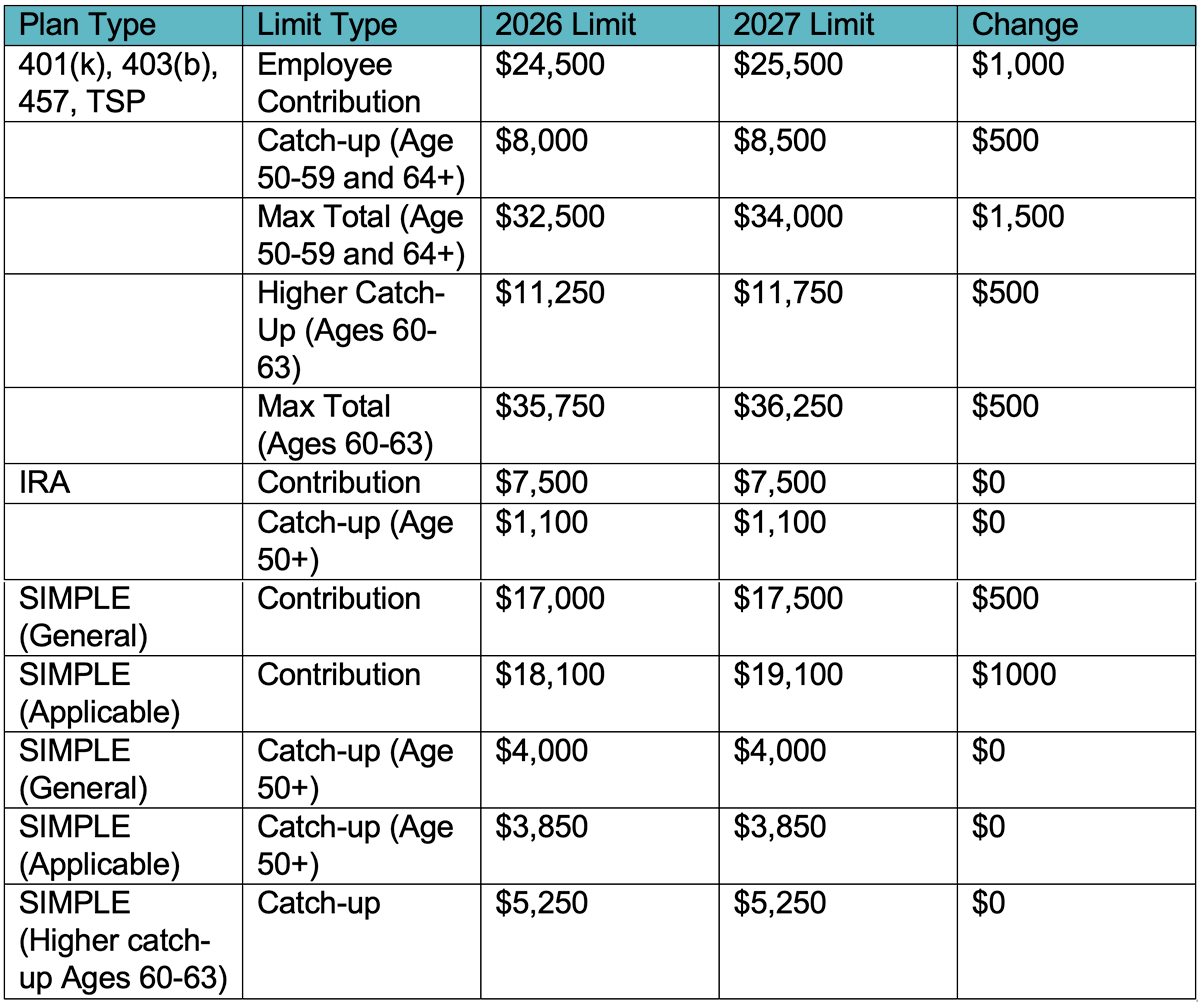
Below is a summary of the contribution limits and catch-up limits for various retirement vehicles in 2027.
Please let the team at GT Reilly & Company know if you have questions for your employer-sponsored plan or for individual contribution planning.
Annual Benefit and Wage Limits
The annual additions limit, which is the combined employee and employer contributions for defined contribution plans, was increased to $75,000, up from $72,000. For defined benefit plans such as employer-sponsored pensions, the annual benefit limit will be raised to $300,000 in 2027 from $290,000 in 2026.
The annual compensation limit for defined contribution, defined benefit and SIMPLE plans, which limits the amount of employee compensation that can be utilized when determining contributions or benefits for these plans, was increased to $375,000 for 2027, up from $360,000 in 2026.
Other Key Adjustments for 2026
- • SIMPLE Plans: The limit on elective deferrals to a SIMPLE IRA or SIMPLE 401(k) plan is increased from $17,000 to $17,500.
- • Roth Catch-up Requirement: The FICA wage threshold that determines if catch-up contributions must be designated as Roth contributions is increased from $150,000 to $155,000.
- • Highly Compensated Employee (HCE) Threshold: The limit on compensation used to identify a “highly compensated employee” is increased from $160,000 to $170,000.
- • Social Security Wage Base: The maximum amount of earnings subject to the Social Security tax (taxable maximum) will increase from $184,500 to $192,300.
Deduction Phase-Outs By Income
Phase-out Ranges for Traditional IRAs
- • Single taxpayers: 2027 phase-out range is increased to between $83,000 and $93,000, up from $81,000 and $91,000 for 2026
- • Married couples filing jointly: 2027 phase-out range is increased to between $133,000 to $153,000, up from $129,000 and $149,000 for 2026
- • IRA contributor married to someone who is covered by a workplace plan: 2027 phase-out range is increased to between $250,000 to $260,000, up from $242,000 and $252,000 for 2026
- • Married individual filing separately: 2027 phase-out range is not subject to an annual cost-of-living adjustment and remains between $0 and $10,000
Phase-out Ranges for Roth IRAs
- • Single taxpayers and heads of household: 2027 phase-out range is increased to between $158,000 to $173,000, up from $153,000 and $168,000 for 2026
- • Married couples filing jointly: 2027 phase-out range is increased to between $250,000 to $260,000, up from $242,000 and $252,000 for 2026
- • Married individual filing separately: 2027 phase-out range is not subject to an annual cost-of-living adjustment and remains between $0 and $10,000
Saver’s Credit Income Limit
- • Married filing jointly: $83,000, up from $80,500 for 2026
- • Heads of Household: $62,250, up from $60,375 for 2026
- • Single taxpayers and married individuals filing separately, $41,500, up from $40,250 for 2026
See Also: 2026 Charitable Deductions